
What Held Me
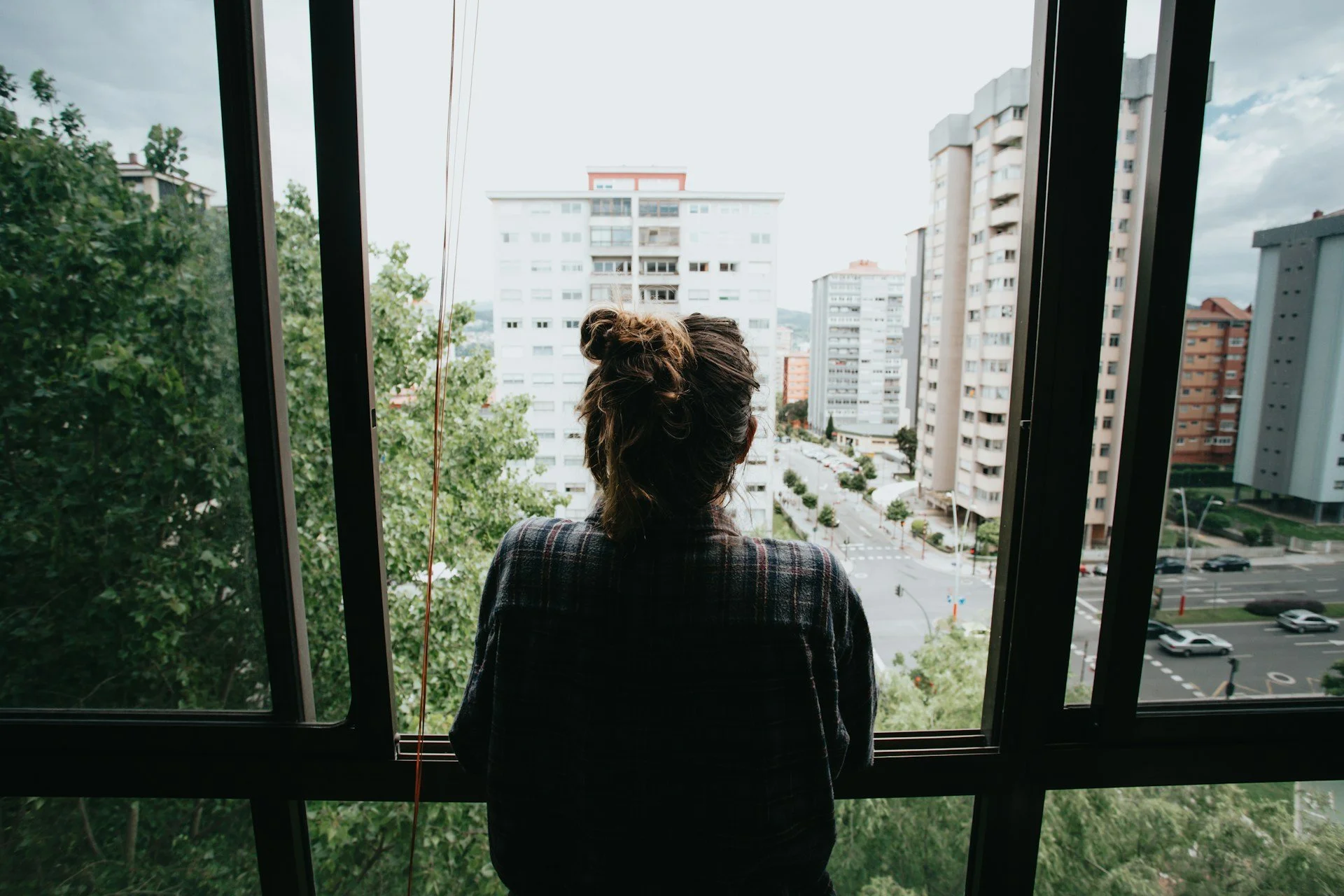
I borrowed stability. The loan was called in.
What Holds Series – Part 2
It Happened in Layers
I want to tell you about the year the floor gave out.
It didn't happen all at once. It happened in layers, each one arriving before I'd finished processing the one before it — which is, I've come to think, exactly how the most destabilizing seasons work. Not a single catastrophic event you can point to and say: there, that's when it happened. Just an accumulation of removals, one after another, until you reach for the thing that was supposed to hold you and find it isn't there.
The first layer was COVID. It arrived in March of my youngest’s senior year — which meant it took the ending. Not the whole year, but the part that matters most: prom, graduation, the last few months with friends before everyone scatters to their separate futures. The ceremonies that tell you something significant happened and is now complete. The proper goodbye. All of it cancelled, or diminished into something unrecognizable, leaving a chapter that simply stopped rather than closed.
Then he left for college. A month or two later, we moved to Bogota.
I want to sit with that sequence for a moment, because the timing matters. He left first — and then we moved. Which meant the empty house had a month or two to be just that: empty. No new city to explore, no distraction of arrival, no forward motion to soften what was gone. Just the particular silence of rooms that used to hold a child and now didn't. And then, before I had finished feeling what that was, we were in Colombia. New country, new city, a language I didn't speak well enough to have a real conversation in. There was an embassy community, which meant there were people around. But surface connections are their own particular kind of loneliness — the shape of belonging without the substance of it, people present but unreachable in the ways that actually matter.
A Role Is Not a Self
I had spent thirty years being the foundation. I held everyone else steady — the children, the household, the endless logistics of a life that moved constantly — so that Dave could succeed and the family could function. I was good at it. I had mistaken being good at it for being sustained by it.
When the role disappeared, I discovered the difference.
What I had been gripping — the identity of mother as the answer to the question of who I was — turned out not to be load-bearing at all. It was a role. A real and meaningful and deeply loved role, but a role nonetheless. And roles, it turns out, are not the same as a self. When this one was removed, I expected to find something underneath it. What I found instead was the bewildering, disorienting experience of not knowing what was there.
The psychologists call it purpose loss — and the research is more serious than the phrase suggests. Studies on meaning and wellbeing consistently show that the absence of purpose isn't just an emotional experience. It registers in the body. It affects cognition, immune function, cardiovascular health. Viktor Frankl, writing from the extremity of a concentration camp, identified what he called an existential vacuum — the experience of having no answer to the question what for? — as one of the most destabilizing conditions a human being can inhabit. He wasn't describing dramatic suffering. He was describing the particular hollowness of a life that has lost its orientation. Its telos. The sense that it is pointed at something that matters.
I had built my telos entirely around other people's needs. Which worked beautifully, right up until the needs were elsewhere.
Carol Dweck's research on fixed versus growth mindset is usually applied to achievement — to whether people believe their abilities can develop or are permanently set. But I've come to think the deeper application is to identity. A fixed identity is one built entirely on what you do, what role you fill, what others need from you. It feels stable until the role ends. And then it doesn't feel like anything at all, because there was never a self underneath — only a function. The stability was borrowed from the structure, not from within.
I had a borrowed stability. Bogota called the loan.
What Held When Everything Else Didn't
What I found underneath — and I want to be honest that finding it was neither quick nor linear — was something I can only describe as a sense of being known by something larger than circumstance. My faith had always been present, had always been, in some background way, the water I swam in. But I had not understood until it was the only thing left how load-bearing it actually was. Not as doctrine. Not as a set of rules or requirements or performances. As a felt sense — however imperfect my access to it — that I was not random. That there was a plan holding even when I couldn't see it. That being known didn't require being needed.
That is harder to articulate than I'd like, and I'm aware it will land differently depending on what you carry into it. I'm not asking you to share my belief. I'm telling you what held when everything else didn't.
The other thing that held was a sentence.
Early in our marriage — young, still learning how to fight without destroying what we were building — Dave and I had developed a way of opening hard conversations that changed everything about how we heard each other. Right or wrong, this is how I'm feeling. Five words that removed the argument about whether the feeling was justified and replaced it with the simpler, harder task of just receiving it. You don't have to agree that my feeling makes sense. You just have to let it be real.
We had been saying that to each other for twenty-five years by the time Bogota happened. And when the floor gave out, that sentence — and the marriage it had helped to build — was one of the things I could stand on. Not because Dave fixed it. He couldn't. But because I had a relationship in which I was allowed to be lost without being required to perform otherwise. That turned out to matter enormously.
Differently Alone
Dave deployed to Pakistan the following year.
I was alone again — but differently alone. The crisis in Bogota had already begun the work that I hadn't known needed doing. The identity that had been yanked out from under me had, in the intervening months, started to be replaced by something that belonged more fully to me. Not a role. Not a function. Something closer to a self.
The deployment year became the first extended proof that it was real.
I won't pretend the proof arrived immediately or easily. There were hard days in that house — alone in a way I had never been as an adult, without children, without the daily weight of being needed, without the structure that had organized my life for three decades. The silence had a texture I had to learn to sit with before I could learn to inhabit it.
But something was different from Bogota. When the floor gave out in Colombia, I fell through it. During the deployment, I stood on it. Shakily, uncertainly, with more questions than answers — but standing. Which meant something had been built in the interval, even if I couldn't have told you exactly what or when.
Frankl observed that the last human freedom — the one that cannot be taken by any external force — is the freedom to choose one's response to circumstances. I don't invoke that lightly. My circumstances were not extreme. But the principle held in a quieter register: what Bogota stripped away was the illusion that my stability came from outside me. What the deployment confirmed was that it didn't have to. That something had been there all along, underneath the role and the function and the performance of being fine — something that belonged to me specifically, that moved when I moved, that didn't depend on a location or a community or a child who still needed picking up from school.
That is what portable identity actually means. Not a framework. Not a methodology. A discovery, made under pressure, that the self you've been looking for was never somewhere else.
Still Unpacking
I am still unpacking what I found in those years. There are things I understood in Bogota and Pakistan that I am only now, in the relative stillness of building something new, beginning to articulate. This blog, this business, the work I do with people navigating their own versions of the floor giving out — all of it traces back to those seasons. To the gripping that didn't hold. To the sense of being known by something larger than circumstance. To a sentence about feelings that a young couple learned to say to each other and never stopped.
What held me was not what I expected. It was not the roles I had mastered or the stability I had constructed or the community I had carefully assembled in each new place. It was older and quieter and more interior than any of that.
Which raises the question I want to spend the rest of this series exploring: if what holds a person is that interior — that personal, that specific — what holds everyone else? What holds a community? What holds the connections between strangers who have no shared history, no common crisis, no thirty-year marriage to fall back on?
That's the harder question. And it starts, I think, in the most unlikely place — on a military base, with a child making friends as fast as possible because she knows she won't be staying long.
Next in the series: We're Only Here for a Little While, So Let's Be Friends Fast.
